
Painted Woodlouse (Porcellio spinicornis)
Matias Mustonen, 26 August 2026
GENERAL
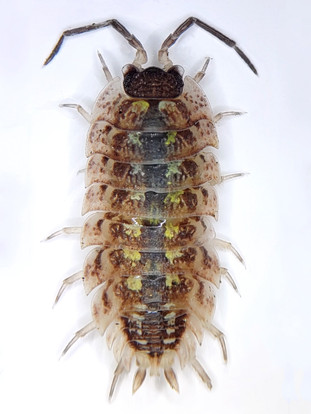
The Painted Woodlouse (Porcellio spinicornis) is a large and strikingly coloured woodlouse species that is commonly found near buildings, particularly at old cultural sites.
IDENTIFICATION
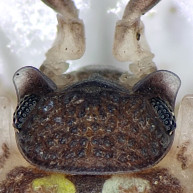
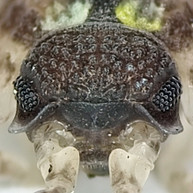
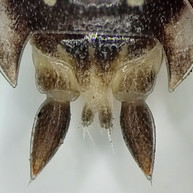
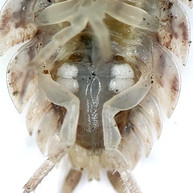
The Painted Woodlouse grows to approximately 12–17 mm in length. The pale brown back has a dark longitudinal stripe running along the middle, usually flanked on both sides by a row of sulphur-yellow spots. The head is distinctly dark, and its shape, with protruding cheeks and a convex forehead, is characteristic of the species. The basal segments of the antennae have small spine-like projections, to which the scientific name 'spinicornis' refers. The tip of the telson is short, triangular and pointed. On the underside there are two pale pairs of lungs, characteristic of the family Porcellionidae.
HABITS
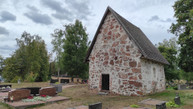
The Painted Woodlouse is associated with human habitation and is generally found close to buildings, particularly at old cultural sites. It feeds on decaying plant material. It tolerates relatively dry and sunny environments and prefers calcareous soils. During the day it hides under stones and pieces of wood. At night it can be found climbing on building foundations and walls. To look for the species, old medieval churchyards, for example, can be good places to explore, as their soil is often calcareous. The locally occurring Curly Woodlouse (Cylisticus convexus) can also be found at some of the same sites. An insect exhaustor and plastic tubes are useful tools when collecting woodlice for closer examination.
DISTRIBUTION
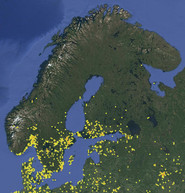
The Painted Woodlouse is a European species that has also been introduced to North America by human activity. It may have reached Finland through human activity as early as ancient times and is therefore considered an archaeophyte. In Finland, the Painted Woodlouse is common in the southern parts of the country. As of August 2026, the northernmost known records in Finland are from Kokkola.
SIMILAR SPECIES
Common Woodlouse (Oniscus asellus) – often resembles the Painted Woodlouse in colouration, but the pale pairs of lungs on the underside are absent and the antennal flagellum has three segments.
LITERATURE
Enckell, P. H. 1980: Kräftdjur. Signum, Lund.
Gregory, S. 2009: Woodlice and waterlice (Isopoda: Oniscidea & Asellota) in Britain and Ireland. FSC Publications, Shrewsbury.
Mustonen, M. & Savin, J. 2025: Maasiirojen (Isopoda: Oniscidea) suomenkielinen nimistö sekä täydennyksiä Suomen laji- ja maakuntaluetteloihin. Sahlbergia 31.1: 12–18.
Palmén, E. P. 1945: Maasiirat – eräs tutkimuksemme laiminlyömä eläinryhmä. Luonnon ystävä 49 (6): 232–239.
Palmén, E. P. 1946: Die Landisopoden Finnlands. Annales Zoologici Societatis Zoologicae Botanicae Fennicae Vanamo 11 (6): 1–35.
Schmalfuss, H. 2003: World catalog of terrestrial isopods (Isopoda: Oniscidea). Stuttgarter Beiträge zur Naturkunde, Serie A, 654.
Silfverberg, H. 1999: A provisional list of Finnish Crustacea. Memoranda Societas pro Fauna et Flora Fennica 75: 15–37.
Suomen Lajitietokeskus. 2026: Keltatäpläsiira – Porcellio spinicornis. https://laji.fi/taxon/MX.214422
Maps: GBIF
Photos: Matias Mustonen