
Curly Woodlouse (Cylisticus convexus)
Matias Mustonen, 7 September 2026
GENERAL
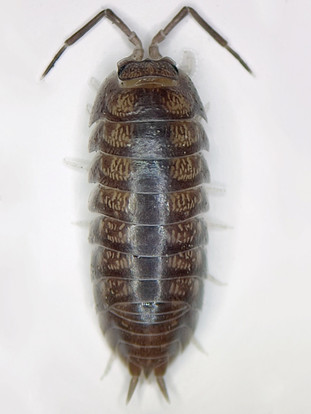
The Curly Woodlouse (Cylisticus convexus) is a large woodlouse species that rolls into a ball when disturbed. It occurs locally in old cultural environments and in calcareous woodlands.
IDENTIFICATION
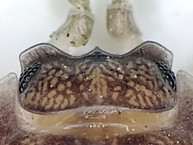
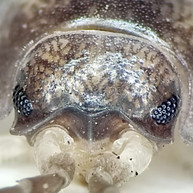
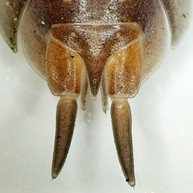
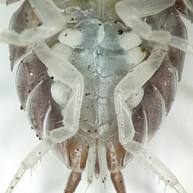
The Curly Woodlouse grows to approximately 11–15 mm in length. The dorsal surface is usually brownish grey with yellowish-brown marbling. The cheeks are lobed and the frontal shield is pointed. The flagellum of the antenna consists of two segments. The telson is elongated and somewhat pointed. The uropods are long and often strikingly orange-red. The underside has five pairs of pale lungs, as in the Rough Woodlouse (Trachelipus rathkii). When disturbed, the Curly Woodlouse rolls into a ball, much like species of Armadillidium.
HABITS
The Curly Woodlouse is a calcophilous species, and in Finland it may originally have inhabited calcareous woodlands in the southern parts of the country. It has, however, benefited considerably from human activity and is most easily found in old built-up cultural environments, such as the grounds of medieval castles and churches, where the soil is often rich in calcium carbonate. The Painted Woodlouse (Porcellio spinicornis) can usually be found in the same places. Like other woodlice, the Curly Woodlouse feeds on decaying plant matter.
DISTRIBUTION
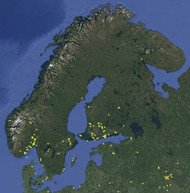
The Curly Woodlouse is a European species that has been introduced by humans to North America and North Africa. In Finland, it occurs in the southern and central parts of the country. As of September 2026, the northernmost known Finnish record is from Oulu, although this observation does not appear on the GBIF map.
SIMILAR SPECIES
The Curly Woodlouse resembles the Rough Woodlouse (Trachelipus rathkii) in colouration, and the latter also has five pairs of pale lungs on the underside. The uropods of the Curly Woodlouse are, however, notably long and usually distinctly orange-red. The Rough Woodlouse is also unable to roll into a ball like the Curly Woodlouse.
When rolled up, the antennae and uropods of the Curly Woodlouse protrude from the outside of the ball, unlike in species of Armadillidium. The antennae and uropods of Armadillidium are considerably shorter, and their rolled-up body forms a more distinctly spherical ball.
LITERATURE
Enckell, P. H. 1980: Kräftdjur. Signum, Lund.
Gregory, S. 2009: Woodlice and waterlice (Isopoda: Oniscidea & Asellota) in Britain and Ireland. FSC Publications, Shrewsbury.
Mustonen, M. & Savin, J. 2025: Maasiirojen (Isopoda: Oniscidea) suomenkielinen nimistö sekä täydennyksiä Suomen laji- ja maakuntaluetteloihin. Sahlbergia 31.1: 12–18.
Palmén, E. P. 1945: Maasiirat – eräs tutkimuksemme laiminlyömä eläinryhmä. Luonnon ystävä 49 (6): 232–239.
Palmén, E. P. 1946: Die Landisopoden Finnlands. Annales Zoologici Societatis Zoologicae Botanicae Fennicae Vanamo 11 (6): 1–35.
Schmalfuss, H. 2003: World catalog of terrestrial isopods (Isopoda: Oniscidea). Stuttgarter Beiträge zur Naturkunde, Serie A, 654.
Silfverberg, H. 1999: A provisional list of Finnish Crustacea. Memoranda Societas pro Fauna et Flora Fennica 75: 15–37.
Suomen Lajitietokeskus. 2026: Linnasiira – Cylisticus convexus. https://laji.fi/taxon/MX.214428
Maps: GBIF
Photos: Matias Mustonen